Fiber Laser Tube Cutting: What to Consider Before Buying
What Is Fiber Laser Tube Cutting?
Fiber laser tube cutting is a method of processing metal pipes and tubes with a focused fiber laser beam. Instead of relying on manual sawing or traditional mechanical cutting, the laser system uses a controlled beam to cut the material according to programmed dimensions and shapes.
For metal fabrication, the main advantage is the ability to produce precise cuts while reducing the amount of additional edge cleanup required after cutting.

A fiber laser tube cutting machine can be used for different types of metal tube and pipe processing, depending on the machine configuration, laser power and cutting requirements. Common materials include carbon steel, stainless steel and aluminum.
The right machine should be selected according to the materials you process, the tube sizes you need to cut and the type of production you handle.
Fiber Laser Tube Cutting vs. Plasma and Manual Sawing
Different cutting methods can be suitable for different production requirements. Fiber laser tube cutting is particularly useful when manufacturers need accurate cuts and repeatable processing.
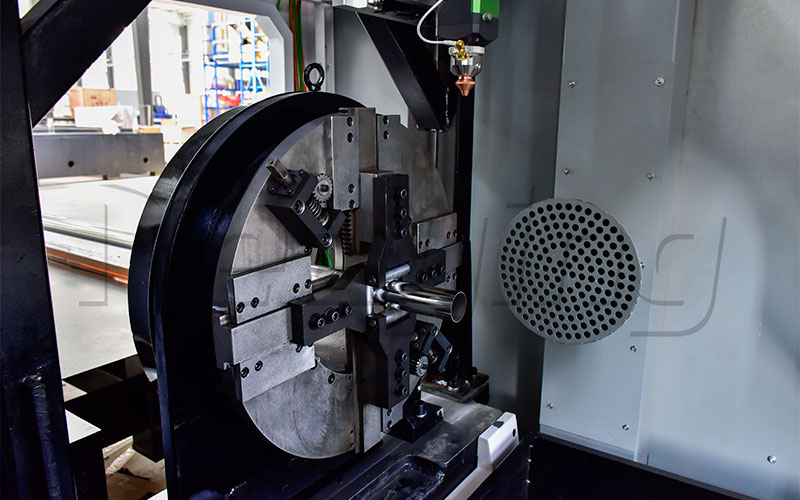
Manual sawing can work for simpler cutting tasks, but it usually requires more manual handling and may involve additional finishing work.
Plasma cutting can process metal efficiently, but the final cutting result depends on the material, thickness, process settings and equipment configuration.
Fiber laser tube cutting is often considered when the production process requires:
- Precise tube and pipe cutting
- Consistent cutting results
- Complex programmed shapes
- Reduced secondary finishing work
- More automated production
The actual result still depends on the laser power, cutting head, machine structure, chuck system, assist gas and process parameters.
What Materials and Tube Shapes Can Be Cut?
The materials and tube profiles that a fiber laser tube cutting machine can process depend on the specific machine configuration.
Before buying a machine, check both the supported materials and the tube dimensions.
Round, Square and Rectangular Tubes
Tube laser cutting systems can be configured for different tube profiles, including round, square and rectangular tubes.
Some machines are also designed for additional profiles such as oval, angle, channel and other special-shaped materials.
For this reason, it is important to provide your actual tube dimensions and profiles when selecting a machine instead of choosing a model based only on laser power.
Carbon Steel, Stainless Steel and Aluminum
Fiber laser tube cutting machines can be used for a range of metal materials, including carbon steel, stainless steel and aluminum.
Different materials require different cutting parameters. Material thickness, surface condition, gas selection and laser power can all affect the cutting result.
When purchasing a machine, it is better to test your actual material rather than relying only on general specifications.
What Should You Check When Choosing a Tube Laser Cutting Machine?
Choosing a fiber laser tube cutting machine is not simply a matter of selecting the highest laser power.
The machine should match your tube size, production volume, material type and required cutting quality.
Cutting Range and Tube Size
Start with the tube dimensions used in your production.
Check the minimum and maximum tube diameter, tube length and supported profiles. A machine designed for smaller tubes may not be suitable for larger pipes or special-shaped sections.
For example, Reaying’s automatic tube cutting systems can be configured for different tube sizes and profiles, so the correct model depends on your actual production requirements.
Laser Power and Cutting Requirements
Laser power should be selected according to the material and thickness you need to process.
Higher power is not automatically better for every application. A suitable configuration should provide enough cutting capacity for the materials and thicknesses in your normal production range.
Before ordering, prepare a list of your most commonly processed materials and thicknesses. This makes it easier to determine the appropriate laser power and machine configuration.
Chuck and Tube Clamping
The chuck system is an important part of a tube cutting machine because it holds and positions the workpiece during cutting.
Stable clamping helps maintain the position of the tube during processing. The chuck should also match the size and shape of the materials you plan to process.
For production involving different tube profiles, ask the supplier which clamping configuration is suitable for your materials.
Positioning and Repeat-Positioning Accuracy
Accuracy is another important point when comparing fiber laser tube cutting machines.
Do not look at a single accuracy number without checking how the manufacturer defines it.
For example, different machine configurations may list different positioning accuracy and repeat-positioning accuracy specifications. These values should be reviewed together with the actual machine model and technical table.
For your own application, the most useful test is to process your real tubes and check the dimensions and repeatability of the finished parts.
Control System and Automation
The control system affects how the operator prepares files, adjusts cutting parameters and manages production.
For higher-volume tube processing, automation can also reduce manual handling.
Depending on the machine design, automated functions may include tube feeding, clamping, centering and cutting.
When comparing machines, ask how much of your normal production process can be automated.
Why Cutting Quality Matters in Tube Fabrication
Cutting quality affects what happens after the tube leaves the laser machine.
A clean and accurate cut can reduce additional grinding, adjustment or preparation before the next production step.
This is especially important when tubes are used for assemblies where multiple parts need to fit together.
The quality of the finished cut depends on several factors, including:
- Laser power
- Cutting speed
- Assist gas
- Material thickness
- Cutting parameters
- Cutting head condition
- Machine positioning
- Tube stability during processing
For this reason, machine specifications are only part of the selection process. Real material testing is still important.
Fiber Laser Tube Cutting: Setup and Maintenance
A tube laser cutting machine should be installed and maintained according to the manufacturer’s requirements.
Before production starts, the machine should be properly installed and checked. Operators should also understand the control system, cutting parameters and basic maintenance procedures.
Routine maintenance can include checking and cleaning optical components, monitoring coolant where applicable, and inspecting lubrication and other machine components according to the manufacturer’s maintenance schedule.
Keeping the cutting system clean is particularly important because contamination can affect cutting performance.
Operators should also pay attention to assist-gas lines and related components to make sure the gas supply remains stable during production.
A simple maintenance routine can help prevent avoidable interruptions and keep cutting performance more consistent.
What Should You Test Before Buying a Fiber Laser Tube Cutting Machine?
A machine specification sheet cannot answer every question about your application.
Before buying, prepare samples of the actual tubes and materials you normally process.
During a machine test, pay attention to:
Material Compatibility
Test the materials and thicknesses that are important to your production.
Tube Size and Profile
Test the actual tube diameters, dimensions and profiles used in your work.
Cutting Quality
Check edge quality, dimensions, finished geometry and the amount of secondary cleanup required.
Repeatability
Run multiple parts where possible to check whether the machine produces consistent results.
Machine Operation
Check how easily operators can load the material, prepare the cutting program and adjust production parameters.
Service and Spare Parts
Ask the supplier about installation, operator training, maintenance support and spare parts availability.
This process is much more useful than choosing a machine only from a catalog specification.
Reaying Fiber Laser Tube Cutting Machines
Reaying provides fiber laser cutting equipment for metal sheet and tube processing.
For tube cutting applications, Reaying’s product range includes machines designed for automated tube feeding, clamping, centering and cutting. Depending on the model, supported materials include carbon steel, stainless steel, aluminum and other metals, while supported tube profiles can include round, square, rectangular and other shapes.
For example, the Customized Version of Automatic Tube Fiber Laser Cutting Machine is designed for automatic tube processing and supports different tube profiles and material requirements. The exact laser power, cutting range and machine configuration should be selected according to your production needs.
You can learn more about the related machine here:
Fiber laser tube cutting machine:
https://www.reaying.com/products/all-new-design-professional-fiber-laser-pipe-cutting-machine/
How to Get Better Results From Fiber Laser Tube Cutting
Good cutting results do not depend on the machine alone.
Before production, operators should confirm the material, thickness, tube profile and cutting requirements. A test cut can help determine whether the selected parameters are suitable.
It is also important to keep the cutting optics clean and inspect the machine regularly.
For a new application, a practical approach is to:
- Test the actual material.
- Check the finished dimensions.
- Adjust cutting parameters based on the test.
- Inspect the cutting edge.
- Repeat the test when changing material or thickness.
This is a more reliable approach than using exactly the same settings for every type of metal tube.
Is a Fiber Laser Tube Cutting Machine Right for Your Production?
A fiber laser tube cutting machine can be a good option for manufacturers that regularly process metal pipes and tubes and need consistent, programmable cutting.
It is especially worth considering when your production involves:
- Regular tube and pipe cutting
- Multiple tube sizes
- Repeated production jobs
- Complex programmed shapes
- A need for consistent dimensions
- A reduction in manual cutting and secondary finishing work
However, the best machine depends on your actual materials, tube sizes, thicknesses and production volume.
There is no single machine configuration that is ideal for every manufacturer.
Conclusion
Choosing a fiber laser tube cutting machine should start with your actual production requirements rather than laser power or machine appearance alone.
Check the materials you process, tube sizes and profiles, cutting requirements, machine accuracy, chuck configuration, control system, automation and after-sales support.
Most importantly, test the machine with your own material and production requirements before making a final decision.
A properly matched fiber laser tube cutting system can provide accurate and repeatable tube processing while making the overall production process easier to manage.
Need Help Choosing a Fiber Laser Tube Cutting Machine?
Not sure which tube cutting configuration is suitable for your materials and production requirements?
Reaying can help you compare the appropriate machine configuration based on tube size, material, thickness and cutting requirements.
Contact Reaying to discuss your fiber laser tube cutting application.
Need Help!!!
Categories
Recent Post

Tag Cloud
About Reaying
Shandong Reaying Machinery Co., Ltd. is one of the leading laser machine manufacturers around the world since 2008 with a registered capital of 3 million yuan. It is a high-tech enterprise focusing on R&D...
Read More