A pulsed laser cleaning machine releases energy in short pulses, while a continuous-wave laser delivers a continuous beam during operation. Neither technology is the best choice for every cleaning task. The right option depends on the base material, the type and thickness of contamination, the size of the workpiece and the condition that the cleaned surface must maintain.
This guide explains the differences between pulsed and continuous laser cleaning machines, when each type may be suitable, and what to check before choosing a system for your production needs.
What Is a Pulsed Laser Cleaning Machine?
A pulsed laser cleaning machine delivers laser energy in separate pulses rather than as an uninterrupted beam. The pulse characteristics and processing parameters can be adjusted according to the laser source and machine configuration.
This method is often considered for applications where controlled material removal and limited heat input are important. Examples include precision components, mold surfaces, selected weld-cleaning tasks and workpieces with surface finishes that need to be preserved.
Main Advantages of Pulsed Laser Cleaning
Controlled cleaning of precision surfaces
Pulsed laser systems can be suitable for removing contaminants from workpieces where dimensional accuracy, fine surface details or the original finish matter. The result depends on the pulse settings, scanning parameters, material and contaminant.
Reduced heat accumulation in suitable applications
The intervals between laser pulses can help control heat input compared with a continuously delivered beam under otherwise suitable conditions. However, pulsed laser cleaning is not automatically damage-free. Incorrect settings or excessive exposure can still alter a surface.
Useful for localized cleaning
Where contamination needs to be removed from a defined area, a suitable pulsed system may provide the required level of control. The actual cleaning effect should be checked on a representative workpiece before production.
Limitations of Pulsed Laser Cleaning
Pulsed systems are not always the fastest or most economical choice for large areas covered with heavy rust or thick coatings. Productivity depends on the laser’s average power, pulse characteristics, scanning width, contamination and operating settings.
The equipment cost also varies with laser source, power, configuration and accessories. Compare complete quotations rather than assuming every pulsed machine has the same price or operating cost.
What Is a Continuous-Wave Laser Cleaning Machine?
A continuous-wave laser cleaning machine delivers a continuous laser beam while it is operating. Continuous-wave cleaning systems are often evaluated for applications that require relatively high material-removal rates across larger areas or on robust metal workpieces.
For example, some industrial cleaning tasks involve removing heavy rust, old paint or oxide layers from steel structures and large equipment. A suitably configured continuous-wave machine may be considered when cleaning throughput is a major priority.
Main Advantages of Continuous Laser Cleaning
Potentially higher cleaning throughput
Some continuous-wave machines offer higher output power and can remove certain types of contamination efficiently over large areas. Actual performance depends on the configuration, surface condition, contamination thickness and process settings.
Suitable for some heavy-duty cleaning tasks
Continuous-wave cleaning can be a practical option for robust metal components when the required surface condition can be achieved without excessive heat input.
Useful for larger workpieces
For large structures, frames and equipment, a continuous-wave system may offer a suitable balance of cleaning speed and operating requirements. The cleaning path, workpiece geometry and access to the target surface still need to be considered.
Limitations of Continuous Laser Cleaning
A continuous beam can introduce sustained heat into the workpiece. If the laser remains on one area for too long, or the scanning and power settings are unsuitable, the surface may discolor, overheat or become damaged.
This does not mean that every continuous-wave machine damages the base material. It means that thermal effects must be managed through suitable machine settings, operator technique and process validation.
Continuous-wave cleaning may also be unsuitable for some precision or heat-sensitive applications where the required surface condition is difficult to maintain.
Pulsed vs Continuous Laser Cleaning: Key Differences
The following comparison describes typical application considerations. Actual results vary with machine configuration, laser parameters, material and contamination.
| Comparison | Pulsed Laser Cleaning | Continuous-Wave Laser Cleaning |
|---|
| Energy delivery | Energy is delivered in short pulses | Energy is delivered continuously while operating |
| Typical strength | Controlled cleaning for suitable precision applications | Potentially high throughput on suitable large-area jobs |
| Heat management | Can help limit heat input when correctly configured | Requires careful control of sustained heat input |
| Common applications to evaluate | Mold cleaning, precision parts, selected weld areas and sensitive surfaces | Heavy rust or coating removal from robust metal surfaces and larger structures |
| Productivity | Depends on average power, pulse settings, scanning and contamination | Can be faster for certain heavy-duty, large-area tasks |
| Surface protection | Requires correct settings and testing | Requires correct settings and testing |
| Cost | Depends on laser source, power and configuration | Depends on laser source, power and configuration |
The most important difference is how the laser’s energy is delivered and how that affects the particular cleaning process. Laser type alone does not guarantee a specific cleaning speed, finish or cost.
Which Laser Cleaning Machine Is Better for Mold Cleaning?
Pulsed laser cleaning is often worth evaluating first when cleaning molds with fine details, carefully finished surfaces or dimensions that must be preserved. The controlled delivery of energy can be useful when removing residues without unnecessarily heating the mold.
However, mold cleaning requirements are not identical. Some molds may have heavy deposits, different surface treatments or cleaning requirements that call for another configuration. The appropriate choice depends on the mold material, contaminant, surface finish and acceptable cleaning result.
Before purchasing a machine for mold cleaning, check the following:
Mold material: Confirm the actual material and any special surface treatment.
Type of residue: Identify whether the contamination consists of release agents, oil, oxide, carbon deposits or other materials.
Surface requirements: Determine whether dimensions, fine textures, polished regions or surface appearance must be preserved.
Cleaning access: Consider cavities, corners and other areas that may be difficult to reach.
Sample results: Test the proposed machine on a representative mold or suitable sample before approving the process.
Do not make the decision solely on the basis that a machine is pulsed or continuous-wave. The sample result should demonstrate that the contamination is removed to the required level without unacceptable changes to the mold surface.
Which Type Is Better for Rust Removal?
The choice depends on the workpiece and the level of rust.
Light Rust and Precision Metal Parts
For parts where surface appearance, dimensions or thermal effects are important, a pulsed laser cleaning machine may be worth evaluating. It may also be suitable for localized cleaning when precise control over the cleaned area is required.
Heavy Rust on Large Steel Structures
For large, robust steel structures with heavy rust, a continuous-wave laser cleaning machine may be suitable when cleaning throughput is a priority and the required surface condition can be achieved safely.
Before deciding, consider rust thickness, the metal’s condition, the size of the cleaning area and whether the workpiece will be painted, welded or processed further after cleaning.
Thin Sheet Metal and Heat-Sensitive Components
Thin sheets and sensitive components require particular care because excessive heat input may affect the surface or workpiece geometry. A pulsed system may be a better candidate for evaluation, but the actual material and required result still need to be tested.
There is no single laser type that is best for every rust-removal job. The right system is the one that meets the cleaning requirement while maintaining the necessary condition of the base material.
How to Choose Between Pulsed and Continuous Laser Cleaning
Before requesting a quotation, define the job requirements as clearly as possible.
1. Identify the Base Material
Confirm whether the workpiece is carbon steel, stainless steel, aluminum alloy or another material. Material properties and surface condition can affect how laser energy interacts with the workpiece.
If several materials will be cleaned, list the important material types separately and explain how each part will be used after cleaning.
2. Identify the Contaminant
Describe what needs to be removed, such as rust, paint, oxide layers, grease, welding residue or mold deposits. Contaminant type and thickness can influence the required cleaning process.
Do not assume that a machine suitable for removing light surface rust will provide the same productivity when removing thick paint or heavy contamination.
3. Define the Required Surface Condition
Explain what the workpiece should look like after cleaning. For some applications, removing the contamination is the main objective. Others may require a particular surface appearance, preserved texture or strict dimensional control.
If the surface will be painted, welded, bonded or coated afterward, discuss the requirements of that next production step.
4. Consider Cleaning Area and Output
Estimate the size of the area that must be cleaned and the number of workpieces processed per shift. Include loading, positioning and handling time when evaluating overall productivity.
A machine with a high advertised power rating does not automatically provide the best production result. Request a sample test using the actual material and contamination whenever possible.
5. Compare the Complete Machine Configuration
Review the laser source, rated output, cleaning head, control system, scanning options, cooling arrangement and included accessories. Confirm which items are standard and which require an additional charge.
When comparing pulsed and continuous-wave machines, do not compare power ratings alone. Ask the supplier to explain the proposed configuration and demonstrate whether it meets the cleaning requirement.
6. Review Safety and Maintenance Requirements
Follow the laser classification, manufacturer’s instructions and applicable workplace safety requirements. Consider beam control, suitable laser protective eyewear, work-area access, reflections and fume extraction where required by the material and process.
Ask the supplier about routine maintenance, consumables, operator training and technical support before finalizing the purchase.
How to Test a Laser Cleaning Machine Before Buying
A cleaning sample can help determine whether a proposed system is appropriate for the application.
Provide the supplier with a representative workpiece or sample of the same material and surface condition. Explain the contamination to be removed and the result you expect.
During the test, evaluate:
Contamination removal: Is the required rust, paint, oxide or residue removed?
Base-material condition: Is there unacceptable discoloration, surface damage or change in geometry?
Cleaning consistency: Are the results consistent across the sample and, where necessary, across repeated tests?
Cleaning time: How long does the process take over a defined area?
Operating requirements: Are the proposed settings, working distance and handling method practical for production?
Record the machine configuration and test conditions alongside the results. If cleaning speed is important, confirm how the timing was measured and whether it includes handling and repositioning.
A successful sample does not replace the need to follow the manufacturer’s operating procedures, but it provides a more useful basis for selecting a machine than a general performance claim.
Explore Reaying Laser Cleaning Machines
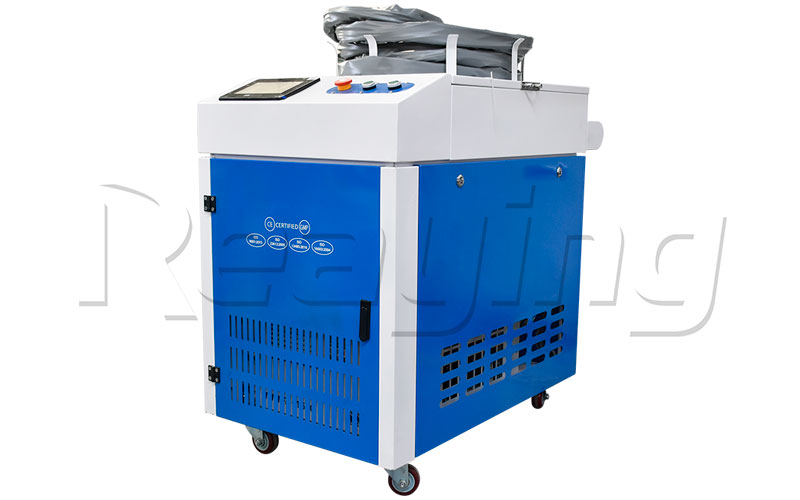
Reaying offers fiber laser cleaning equipment for different metal surface-treatment applications. The suitable configuration depends on the workpiece, contamination, required finish and production workflow.
For a pulsed-cleaning option, review the RY-CL50 fiber laser cleaning machine. Confirm the precise laser source and configuration offered for your quotation.
For larger-area or heavy-duty cleaning requirements, see the continuous handheld laser cleaning machine. Check the exact machine specifications and confirm that the laser mode and parameters match your intended application.
You can also browse the Reaying fiber laser cleaning machine range to compare available options.
Frequently Asked Questions
Is pulsed laser cleaning better than continuous laser cleaning?
Neither is universally better. Pulsed systems are often evaluated for controlled cleaning and applications where heat input needs careful management. Continuous-wave systems may be suitable for higher-throughput cleaning on robust workpieces. The right choice depends on the material, contamination and required result.
Is pulsed laser cleaning suitable for molds?
It is often considered for precision molds where surface details and finish need to be preserved. However, the suitability of a specific machine should be verified using the mold material, contamination and required surface condition.
Can continuous laser cleaning remove heavy rust?
Some continuous-wave machines are designed for heavy rust and large-area cleaning. Performance depends on the machine configuration, rust condition, substrate and processing settings. Test the actual workpiece before selecting a system.
Which machine cleans faster?
There is no universal answer. Continuous-wave machines may offer higher throughput for certain heavy-duty applications, while pulsed systems may be more appropriate for some precision tasks. Compare cleaning time on the same material and contamination under clearly defined test conditions.
Will laser cleaning damage the base material?
Both pulsed and continuous-wave systems can alter a surface if the process is unsuitable or incorrectly set up. Select the machine based on the base material and required surface condition, then verify the proposed settings through testing.
What information should I provide when requesting a quotation?
Provide the base material, type and thickness of contamination, workpiece dimensions, required surface condition, expected production quantity and any subsequent painting, welding or coating requirements. Photos and representative samples can also help the supplier assess the application.
Contact Reaying About Your Laser Cleaning Application
Choosing between pulsed and continuous laser cleaning starts with understanding the workpiece and the required cleaning result. Consider heat input, cleaning productivity, surface condition, machine configuration and safety requirements before making a final decision.
Prepare your material details and cleaning requirements, then contact Reaying to discuss a suitable laser cleaning configuration for your application.