Laser Marking vs. Laser Engraving: Differences, Uses, and How to Choose
Laser marking and laser engraving are both used to add logos, text, serial numbers, QR codes and decorative designs to products. Although the terms are sometimes used interchangeably, the processes can produce different results on a workpiece.
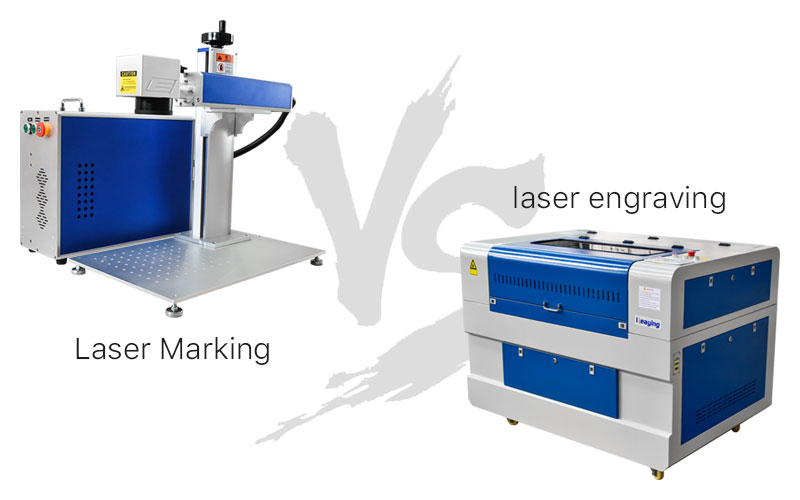
The main distinction is how the laser affects the material. Many laser marking applications change the surface appearance or create contrast with little material removal, while laser engraving removes material to form a visible recess. The actual result depends on the material, laser source, processing parameters and required mark.
This guide explains the difference between laser marking and laser engraving, compares their common applications and helps you choose a suitable laser machine for your work.
What Is Laser Marking?
Laser marking uses a focused laser beam to create identification or decorative information on a material. Common examples include company logos, serial numbers, QR codes, barcodes, model numbers and product labels.
Depending on the material and marking method, the laser may change the surface color, create an oxide layer, alter the appearance of a coating or produce contrast through a surface reaction. Some laser marking processes remove a thin layer of material, so the term does not always mean that the surface remains completely unchanged.
Common Applications of Laser Marking
Laser marking is often used when products need clear, repeatable identification. Common applications include:
- Product serial numbers and traceability codes
- Company logos and brand information
- QR codes and barcodes
- Model numbers and technical labels
- Identification marks on metal components
- Fine graphics and product decoration
The required result varies by application. A QR code must be readable by the intended scanner, while a decorative logo may be judged mainly by its appearance and consistency.
What Is Laser Engraving?
Laser engraving removes material from a workpiece to create a recessed design. The laser heats and removes material along a programmed path, forming an impression that can often be seen and felt.
The resulting depth depends on the material, laser configuration, power, speed, focus, number of passes and other process settings. A deeper engraving generally requires more material removal than a surface-level mark, but there is no single depth that defines every engraving application.
Common Applications of Laser Engraving
Laser engraving is commonly considered for jobs that require a visible or tactile impression, including:
- Engraved nameplates and equipment labels
- Deep or recessed logos
- Decorative patterns on wood and acrylic
- Personalized gifts and product accessories
- Identification on tools and selected metal components
- Designs on leather, plastic and other suitable materials
The appropriate machine depends on the substrate and the required result. A machine suitable for engraving wood may not be appropriate for engraving metal, so material compatibility should be confirmed before purchase.
Laser Marking vs. Laser Engraving: Key Differences
The following comparison summarizes the main practical differences. These are general process characteristics, not fixed rules that apply to every machine or material.
| Factor | Laser Marking | Laser Engraving |
|---|---|---|
| Main purpose | Create identification, contrast or decorative information | Remove material to form a recessed design |
| Material removal | Often little or no significant removal, depending on the method | Material is deliberately removed |
| Surface appearance | May produce a color or contrast change | Usually creates a visible depression |
| Depth | Often shallow, but depends on the marking method | Depends on the required recess and processing conditions |
| Common applications | Logos, serial numbers, QR codes and product identification | Recessed lettering, deeper designs and engraved surfaces |
| Durability | Depends on the material and marking method | The recess may help the design resist surface wear, depending on the application |
| Processing time | Depends on the design, material and settings | Depends on the required depth, area and number of passes |
One important point is that laser marking is also used as a broad term for laser-based identification processes, including some engraving methods. The words “marking machine” and “engraving machine” in a product name do not, by themselves, tell you everything about the machine’s capabilities.
Are Laser Marking Machines and Laser Engraving Machines Different?
They can be different in configuration, but the distinction is not always absolute.
In some product ranges, a laser marking machine is designed mainly for fast, accurate product identification, while a laser engraving machine is configured for a larger work area, different materials or deeper material removal.
However, some laser systems can perform both marking and engraving when the laser source, machine configuration and processing parameters support the required application.
When comparing equipment, look beyond the product name. Check the laser source, wavelength, output power, working area, optical configuration, motion system, software and the materials the machine is designed to process.
If your work mainly involves serial numbers or QR codes on metal parts, a fiber laser marking system may be appropriate. If you need to engrave large wooden panels or acrylic designs, a CO2 laser engraving and cutting system may be a better candidate.
The correct choice depends on the job rather than the machine label alone.
Which Materials Can Be Laser Marked or Engraved?
Different laser sources interact with materials in different ways. The material, surface finish and required marking result should be considered together.
Fiber Laser for Many Metal Marking Applications
Fiber laser marking machines are commonly used for metals such as stainless steel, aluminum and selected copper or other metal components. They are often used for industrial identification, logos, serial numbers and codes.
Some fiber laser systems can also process suitable plastics and perform engraving, depending on the laser source and configuration.
Before choosing a machine, identify the actual material grade and surface treatment. Coatings, anodizing and polished surfaces can change the result, so sample testing is useful when consistent contrast is important.
You can compare the Reaying fiber laser marking machine range to review available equipment.
CO2 Laser for Many Non-Metal Engraving Applications
CO2 laser systems are commonly considered for materials such as wood, acrylic, leather, paper, fabric and selected plastics. Depending on the configuration, a CO2 machine may support engraving, cutting or both.
Applications include signs, craft products, decorative panels, packaging components and personalized products.
Material compatibility must be confirmed before processing. Some plastics and coated materials can produce hazardous fumes or unsuitable results. Follow the equipment manufacturer’s material guidance and ensure that the required extraction and safety controls are in place.
For engraving and cutting applications, explore the Reaying CO2 laser engraving and cutting machine range.
UV Laser for Certain Fine-Marking Applications
UV laser marking machines may be suitable for some plastics, glass, ceramics and electronic components where fine detail or limited thermal impact is important.
The result depends on the material composition, surface properties and marking requirements. Not every glass, plastic or electronic component can be processed in the same way.
If you need fine markings on a heat-sensitive part, request a sample test using the actual material and finish. You can also review the Reaying UV laser marking machine range.
Laser Marking or Laser Engraving: Which Should You Choose?
The easiest way to decide is to define the result the part must achieve.
Choose Laser Marking for Product Identification
Laser marking may be appropriate when the main objective is to add text, serial numbers, QR codes, logos or other identification information.
For example, a manufacturer may need to mark product codes on metal components so they can be identified during assembly, inspection or later maintenance. The main criteria may be readability, consistency and compatibility with the material.
If the mark must be scanned, evaluate code readability using the intended scanner and realistic operating conditions.
Choose Laser Engraving for a Recessed Design
Laser engraving is worth considering when the design needs a visible or tactile recess rather than only a surface contrast change.
Examples include engraved nameplates, decorative patterns, recessed lettering and selected tool or component identification tasks.
If engraving depth is important, define the required depth and surface condition before asking for a quotation. A general claim that a machine can engrave does not guarantee that it can achieve the required depth or finish on your specific material.
Consider Both Processes When Requirements Vary
Some workshops need both surface marking and engraving. For example, a job may require a logo as well as a deeper identification area.
Before purchasing a machine for multiple tasks, confirm that the proposed laser source, power range, software and processing configuration support both results. Request samples for the actual materials and designs instead of assuming that all functions will be equally suitable.
What to Check Before Buying a Laser Machine
1. Material and Surface Condition
Prepare the exact material types you plan to process. Include any coatings, anodizing, polishing or other treatments that may influence the result.
If several materials are involved, identify the main production materials separately. A machine that performs well on one substrate may produce a different result on another.
2. Required Marking or Engraving Depth
Decide whether you need a surface-level contrast mark, removal of a coating or a recessed engraving. If there is a specific depth requirement, state it clearly and ask how it will be verified.
Do not rely on a generic maximum-depth figure without checking the machine configuration and the material used for the test.
3. Mark Size and Working Area
Confirm the dimensions of the part and the area to be processed. Consider whether the workpiece is flat, cylindrical, curved or irregular.
For round or irregular parts, ask whether a rotary attachment or another positioning device is needed. Make sure that the proposed setup accommodates the real workpiece rather than only a flat sample.
4. Required Quality and Readability
Explain what a successful result looks like. You may need high contrast, small readable text, a scannable code, a consistent logo or a specific engraving depth.
Agree on suitable acceptance criteria before testing. This makes it easier to compare results from different machines or configurations.
5. Production Volume and Workflow
Estimate the number of parts to be processed and how often the design changes. Consider part loading, positioning, focusing, code generation, inspection and unloading when evaluating cycle time.
For a production line, check whether the system supports the required data input, automation, protective enclosure and integration with other equipment.
6. Software, Maintenance and Support
Confirm that the software supports your design files and production workflow. If each product needs unique serial numbers or QR codes, clarify how variable information is imported and processed.
Also check installation requirements, operator training, routine maintenance, available replacement parts and after-sales technical support.
How to Test a Laser Machine Before Purchase
A sample test is one of the most useful ways to determine whether a proposed machine matches your application.
Provide a representative workpiece or a sample of the same material and finish. Supply the intended design file and explain whether you need a surface mark, coating removal or a recessed engraving.
During the test, assess the following:
- Appearance: Does the mark or engraving look as required?
- Depth: If engraving is required, does the result meet the specified depth?
- Readability: Can small text and codes be read or scanned as intended?
- Consistency: Do repeated samples produce acceptable results?
- Material condition: Is there any unwanted surface damage or other change?
- Cycle time: How long does the process take under the agreed test conditions?
Ask the supplier to record the machine configuration and test conditions. If you plan to process different materials, test the most important ones rather than assuming that a successful result on one material guarantees the same outcome on another.
A documented sample test provides a more useful basis for selecting a machine than comparing product names or headline specifications alone.
Explore Reaying Laser Marking and Engraving Machines
Reaying offers equipment for laser marking, engraving and cutting applications. The right configuration depends on your material, required result, part dimensions and production workflow.
For metal product identification, review the RY-F20A fiber laser marking machine. Confirm the configuration and options needed for your actual workpieces.
For non-metal engraving and cutting, you can review the RY-L1325S CO2 laser engraving and cutting machine. Confirm that its working area and configuration meet your material and production requirements.
You can also browse the Reaying laser marking machine category to compare available marking technologies.
Frequently Asked Questions
What is the main difference between laser marking and laser engraving?
Laser marking commonly refers to creating surface identification or contrast, often with little material removal. Laser engraving removes material to create a recess. Engraving is also considered one of the processes within the broader field of laser marking.
Is laser engraving more durable than laser marking?
A recessed engraving may resist surface abrasion better in some applications because the design is physically cut into the material. Durability still depends on the material, engraving process, depth and conditions the part will face.
Can one laser machine perform both marking and engraving?
Some machines can perform both processes, depending on the laser source, configuration, software and supported materials. Confirm the required results with the supplier and test representative samples before purchase.
Which machine is suitable for metal marking?
Fiber laser marking machines are commonly used for metal parts. The correct system depends on the metal, surface treatment, required mark and production conditions.
Which machine is suitable for wood and acrylic engraving?
CO2 laser engraving machines are commonly considered for wood and acrylic applications. Confirm the working area, material compatibility, extraction requirements and whether cutting as well as engraving is required.
How do I choose between a fiber laser and a CO2 laser?
Start with the material and desired result. Fiber lasers are commonly used for metal marking, while CO2 systems are widely used for many non-metal engraving and cutting applications. Verify the suitability of the exact material and machine configuration before ordering.
What should I prepare before requesting a quotation?
Prepare the material specification, surface finish, part dimensions, design file, required marking appearance or engraving depth, production quantity and any automation requirements. These details help the supplier recommend a suitable configuration.
Contact Reaying About Your Laser Application
The right machine depends on what you need to mark or engrave, the material being processed and the result your production requires.
Prepare your representative workpiece, design file and acceptance criteria before requesting a quotation. Contact Reaying to discuss the appropriate laser configuration for your application.
Need Help!!!
Categories
Recent Post

Tag Cloud
About Reaying
Shandong Reaying Machinery Co., Ltd. is one of the leading laser machine manufacturers around the world since 2008 with a registered capital of 3 million yuan. It is a high-tech enterprise focusing on R&D...
Read More